

Odd or Even? How RWANFTFI Token IDs Identify Regular and Gift NFTs
October 30, 2026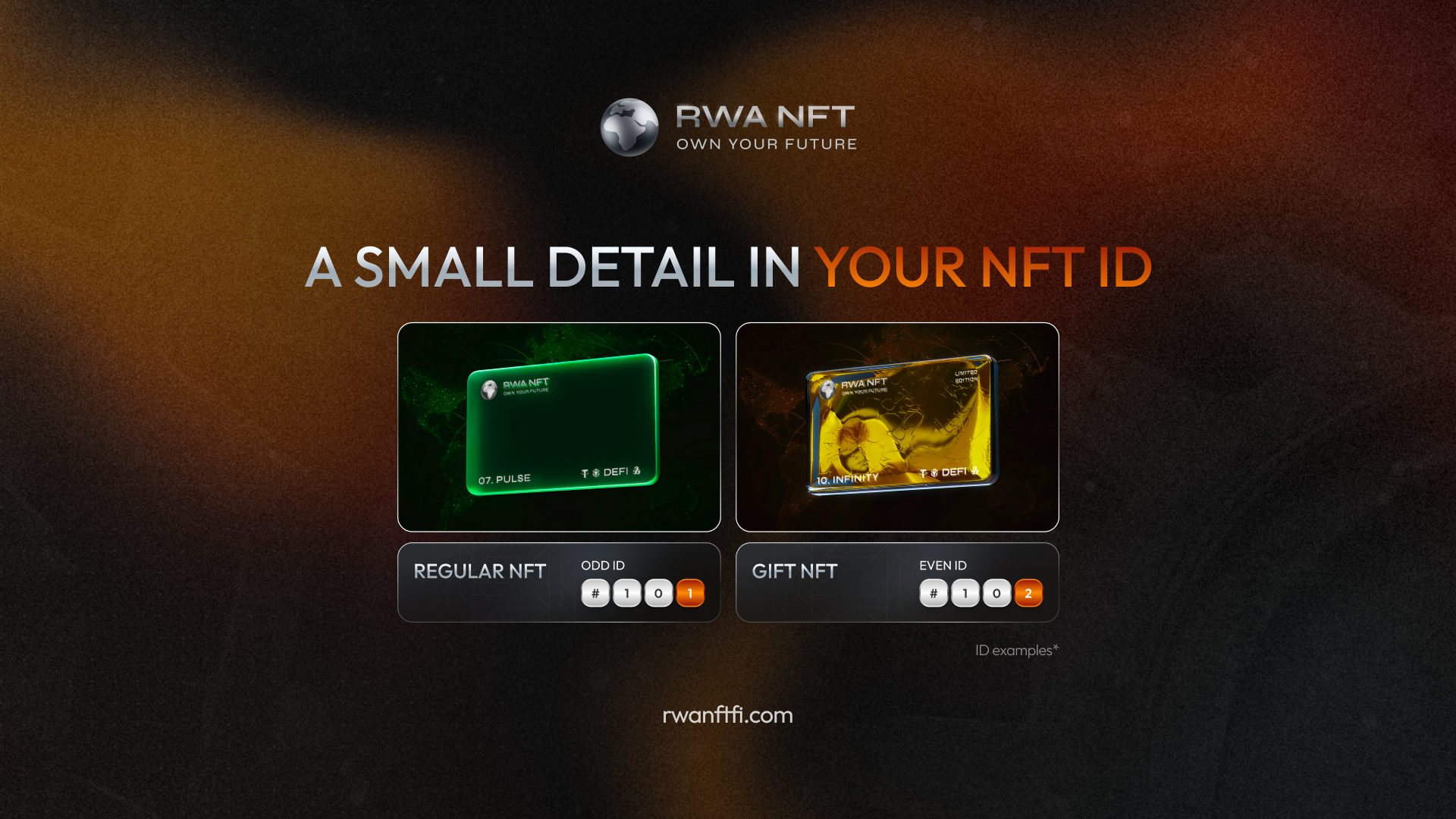
A small detail in your NFT ID tells you something important.
Every RWANFTFI NFT has a Token ID recorded on-chain.
For Regular and Gift NFTs, the protocol uses a simple numbering rule:
Regular NFTs use odd Token IDs
Gift NFTs use even Token IDs
That means you can distinguish these two NFT categories just by looking at the number.
An ID such as 101 is odd, so it identifies a Regular NFT.
An ID such as 102 is even, so it identifies a Gift NFT.
You do not need to interpret the entire number. For determining whether it is odd or even, the last digit is enough.
Odd means Regular
A Regular NFT uses an odd Token ID.
Examples include:
101, 103, 105, 107
Because each of these numbers ends in an odd digit, they belong to the Regular NFT numbering sequence.
Regular NFTs are the NFTs users acquire within the RWANFTFI ecosystem under the applicable protocol rules.
Their Token IDs provide an immediate on-chain distinction from Gift NFTs.
Even means Gift
Gift NFTs use even Token IDs.
Examples include:
102, 104, 106, 108
Each ends in an even digit, which identifies it as part of the Gift NFT category.
Gift NFTs are a separate NFT type within the RWANFTFI ecosystem.
Under the current whitepaper rules, Gift NFTs can be awarded through eligible promotions and program mechanics. They can also be passed on to a future partner and carry their own Protocol Reward Cap.
The even Token ID provides a simple technical way to distinguish them from Regular NFTs.
Token ID and NFT tier are two different things
The numbering rule tells you the category of NFT.
It does not tell you its tier.
An NFT's tier is defined separately.
RWANFTFI currently has 10 NFT tiers, from:
Genesis - L1
through
Infinity - L10
The selected tier determines the applicable features, limits and protocol parameters associated with that NFT.
These include elements such as the Protocol Reward Cap, Partner Network Depth and eligibility for specific ecosystem functions under the current protocol configuration.
So there are two different pieces of information to keep separate:
Token ID parity
Odd or even tells you whether the NFT is Regular or Gift.
NFT tier
Genesis through Infinity determines the NFT's applicable features and limits.
A higher Token ID therefore does not automatically mean a higher tier.
The ID number and the tier serve different purposes.
Why the distinction is useful
NFT interfaces usually display the category and tier directly.
But blockchain assets also exist independently of the interface through their on-chain records.
Knowing the numbering rule gives users another simple way to understand what they are looking at when reviewing NFT information directly.
If the Token ID is odd, it is a Regular NFT.
If the Token ID is even, it is a Gift NFT.
This can be useful when checking NFT details in the application or reviewing on-chain information.
Where to find the Token ID
When viewing the on-chain details of an NFT, look for the field labeled:
Token ID
Then check the final digit.
1, 3, 5, 7 or 9 - Regular NFT
0, 2, 4, 6 or 8 - Gift NFT
The distinction comes directly from the NFT contract architecture documented by RWANFTFI.
Ambassador NFTs are handled separately and use their own contract and configuration, so the odd/even rule described here is specifically for Regular and Gift NFTs.
Simple number, useful information
The rule is intentionally straightforward:
Odd Token ID = Regular NFT
Even Token ID = Gift NFT
The NFT's tier remains separate and defines the features and limits associated with that NFT.
So the next time you open your NFT's on-chain details, take a look at its Token ID.
Sometimes the last digit already tells you what category of NFT you are looking at.
👉 Whitepaper - NFT Contracts: whitepaper.rwanftfi.com/en/architecture#nft-contracts
🌟 rwanftfi.com